

With a fast-changing market and rapidly evolving players, how can you ensure that you offer the best BtoB payment solutions? Your business customers are demanding and attentive to the services you offer. Payment is one of them.
Did you know that 90% of B2B payments that take place offline are mainly due to companies' payment methods not being adapted?
Discover the best payment solutions for the needs of your business customers.
State of the art of the B2B market
The BtoB market is characterized by purchasing processes that are longer and more complex than in BtoC, and by high average shopping baskets. Commercial relations between companies often involve strategic decisions and sometimes complex negotiations.
The increasing digitalization of the BtoB sector has considerably transformed sales processes. In France, BtoB e-commerce represents nearly 700 billion euros in sales (source: Xerfi). According to a Fevad x NextContent study, online sales represent :
- 70% of orders for e-commerce/distance-selling specialists
- 30% of orders from distribution/trade chains
But beyond technology, thecustomer experience plays an essential role. Professionals now have the same high standards as in the BtoC market. In this context, payment plays an essential role and becomes a strategic lever.

Traditional payment methods
Bank transfer
The most common transaction in B2B, credit transfers offer a reliable and secure method of transferring funds between companies. They are made by your business customers from their bank or via online invoicing solutions (which are connected to the company's bank accounts). SEPA credit transfers are generally free of charge. But beneath their seemingly free nature, they conceal a number of hidden costs, mainly linked to their processing (see our article on this subject).
Another specificity of the classic SEPA credit transfer is its execution time, which is generally between 2 and 3 days, increasing your DSO accordingly. However, with the widespread use of instant transfershowever, this average turnaround time will be reduced in the years to come.
Finally, while the traditional credit transfer remains an essential payment method for asynchronous payments, it is not suitable for online sales or physical points of sale.
The bank card
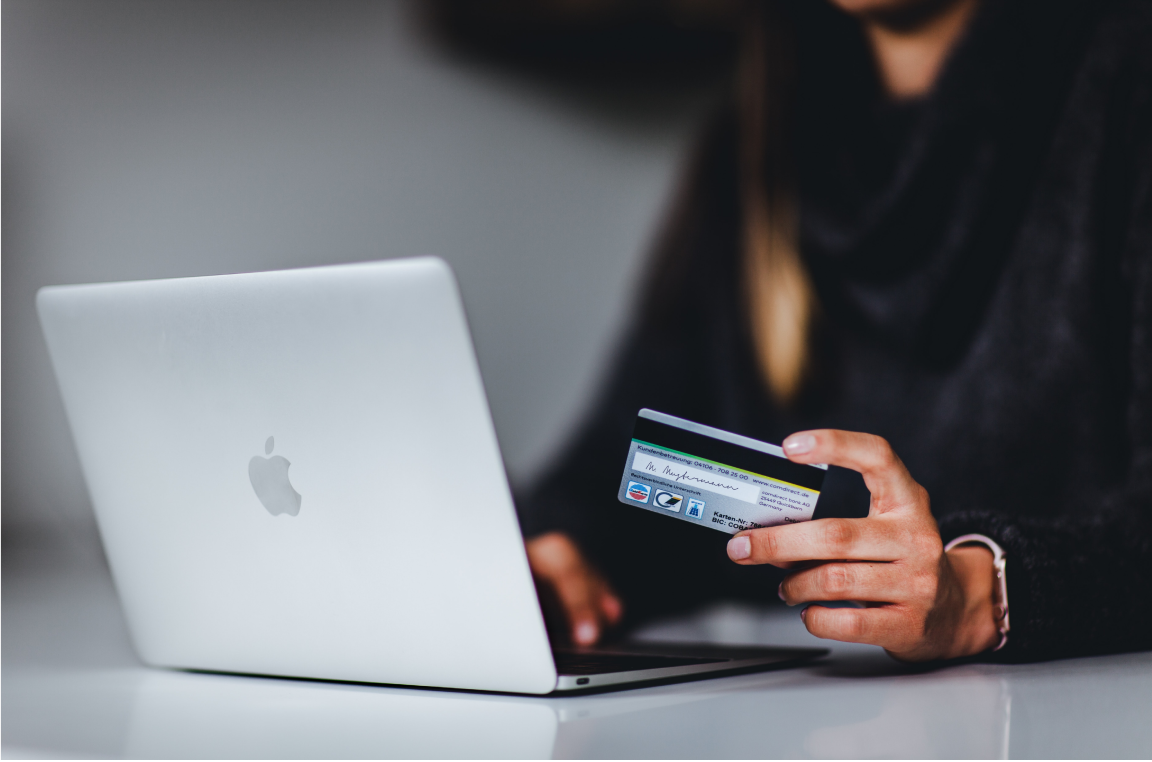
The card has become one of the most important means of payment in recent years. It can be used nationally and internationally, and remains the preferred means of payment for online purchases, even if it is better suited to BtoC.
Particularly well-suited to both physical and online commerce, it offers a fast, simple payment method. What's more, the 3D secure strong authentication protocol has significantly reduced the risk of e-commerce fraud.
On the other hand, in BtoB, bankcards have two major drawbacks. Firstly, it can be very costly for the merchant, with fees ranging from a minimum of 1.2% to sometimes 3%. Secondly, it is subject to limits, which are often restrictive for B2B payments.
The cheque
Although increasingly replaced by electronic payment methods, cheques are still used in certain BtoB transactions, particularly by small professionals. Companies may prefer this method for reasons of tradition, cash-flow flexibility or stakeholder preferences.
However, disadvantages such as longer processing times, the risk of loss or theft, and the need for double-checking, are leading to a decline in the use of cheques.
Direct debit (SDD)
Direct debit, also known as SDD (Sepa Direct Debit), is a payment method that offers an automated, regular solution for recurring payments (e.g. subscriptions). However, its cost is not neutral, especially if you use platforms that dematerialize direct debit mandates.
Payment methods specific to the BtoB sector
Factoring
Reserved for the BtoB market, factoring involves transferring a receivable to a factor (a company specializing in factoring) for rapid financing. The factor "buys" the receivable from you. It then contacts your customer to collect the invoice.
Factoring enables companies to improve their cash flow and reduce their WCR. On the other hand, this payment method comes at a significant cost, which reduces your margins.
The bill of exchange (LCR)
Also reserved for the BtoB market, the bill of exchange is a document in which one person (the drawer) instructs another person (the drawee) to pay an amount to a third party, or to himself (the beneficiary). The bill of exchange can be a means of negotiation between the parties, allowing flexibility in payment terms. Bills of exchange are available in both paper and dematerialized versions.
However, its use has declined due to the administrative complexity and potential risks associated with non-payment, and the growing preference for more modern, automated payment methods.
New BtoB payment solutions
Recent innovations inOpen Banking have led to the emergence of new solutions particularly suited to the BtoB sector.
Supported by favorable European regulations, these new payment methods will gradually revolutionize BtoB payments.
Initiating payment by bank transfer
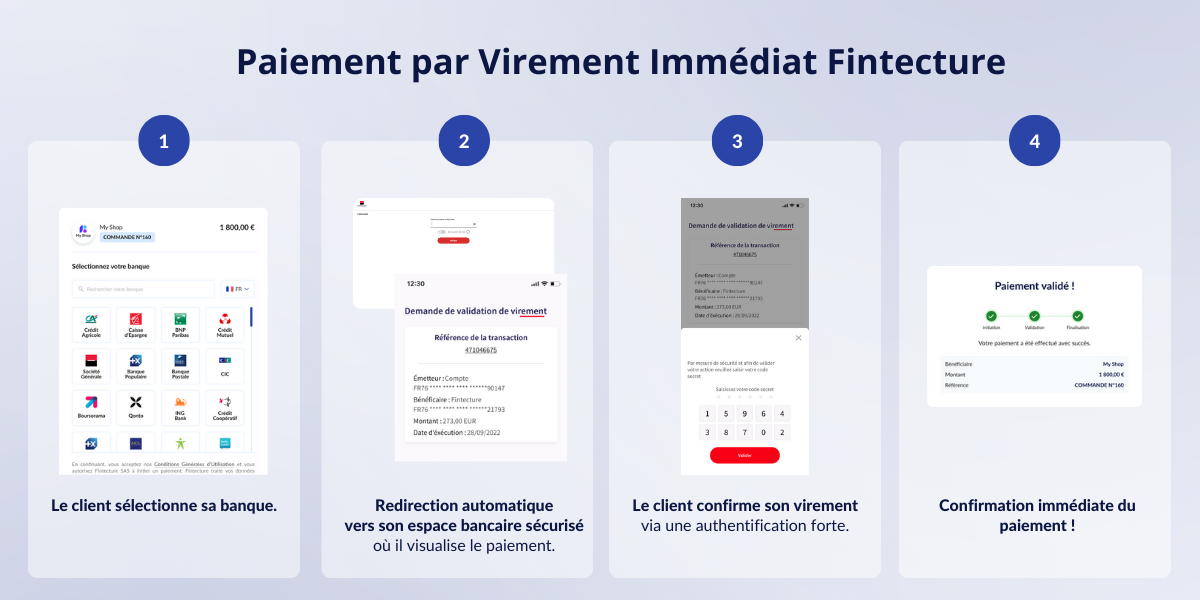
Sometimes referred to as the "Open Banking transfer", payment initiation revolutionizes account-to-account payments. Thanks to a simpler, faster payment process, it makes it possible to collect credit transfer paymentswithout the drawbacks of traditional bank transfers:
- the payer no longer needs to manually enter the payee's IBAN and payment details;
- the merchant receives immediate payment confirmation and reconciliation is automated.
Fintecture offers a Immediate Transfer solution based on this technology. Many BtoB players already offer it to their customers online, remotely or at the point of sale: Edenred, Bricoman, Raja...
Smart Transfer
Initiating payment by bank transfer is a real step forward. However, it requires the buyer to have access to the company's bank accounts, which is not the case in all companies. In BtoB, it is often the accounting department that centralizes payments using specialized software.
To simplify the processing of credit transfer payments, some banks offer virtual IBAN solutions. Fintecture has gone a step further by creating an Intelligent Transfer. Fintecture generates a dedicated IBAN for each customer (by entity or by company) in real time. Coupled with reconciliation algorithms, it identifies the payer and the related invoices, whatever the amount received. Bundled, incomplete or overpaid payments: all payments are reconciled in real time!
Complementary to the Intelligent Transfer, the Intelligent Transfer can be integrated into e-commerce transactions as well as quotations and invoices.
Cashing online, in-store or remotely
As we have seen, BtoB payment solutions have evolved to meet the needs of business customers as closely as possible. Today, they must adapt to another major BtoB trend:omnichannelity.
Whatever the distribution channel, the customer experience must be seamless and optimal. According to a YouGov x GoCardless study, 74% of businesses terminate their online purchase if the process proves too complex.
It is therefore essential to offer simple, secure payment solutions across all your sales channels.
Fintecture's money transfer solutions are available regardless of how you place your order:
- E-commerce: integrate our solutions in just a few clicks using CMS plug-ins or APIs
- Remotely: send payment links by SMS, e-mail or integrate them directly into your invoices
- At the point of sale: generate payment links in the form of QR codes or SMS messages
Conclusion
The evolution of BtoB payment methods, stimulated by innovation and digital technology, has considerably enriched the traditional credit transfer. These new solutions, offering flexibility and modernity, not only simplify transactions, but are becoming essential levers for guaranteeing an optimal customer experience.
In today's competitive environment, these payment services have become an integral part of the process of acquiring and retaining business customers.
Do you have BtoB customers and are you looking for payment solutions tailored to your sector? Contact our Payment Experts


