

Reduce or even eliminate payments by check... You all dream about it! Because if checks are still used, the management of this method of payment becomes a real headache for many merchants.
What are the impacts of the check in your management? Why do your customers pay by check? What alternative solutions can you offer them? All the answers in this article.
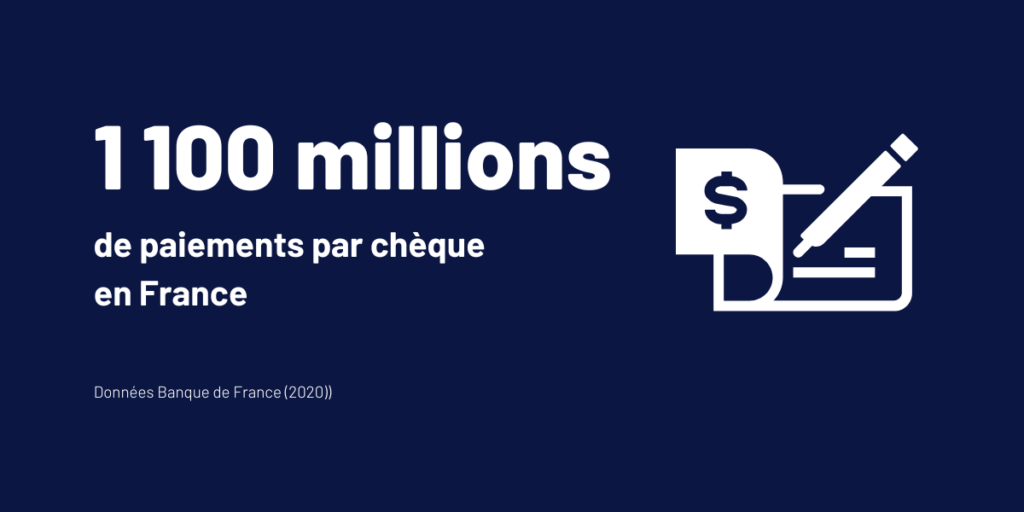
The cheque in a few figures
Cheques are a "scriptural" means of payment, i.e. they enable funds to be transferred by means of a payment order. Introduced in France in the 19th century, it was not widely used at first, but developed massively from the 1950s onwards. Since the 1980s, their use has tended to decline over the years.
In 2020, cheques still accounted for 5% of cashless transactions, i.e. over 1,100 million payments for an average amount of €5221.
France is the European country most attached to cheques: in Europe, 85% of cheque payments are French 1. However, 67% of cheque users say they are using them less often, and 77% believe that cheques will eventually disappear.2
The disadvantages of paying by cheque
Significant hidden costs
Behind its apparent gratuity, the processing of payments by check generates considerable hidden costs. Cashing a check requires various manual and time-consuming (and therefore costly) operations. You must first receive the check, deposit it at your bank, manually enter the amount in your ERP or billing software, find the corresponding order, track the receipt of funds, notify your teams so that they validate and launch the order once your account is credited... In short, a long process, impacting different teams and with a significant risk of error. If you cash one or two checks per month, this processing is acceptable. But if you receive dozens or hundreds of them, it can quickly turn into a nightmare for your accounting teams.
Longer order processing time
How to quickly serve your customers who ask to pay by check? It is impossible to take the risk of sending their order without the certainty of being paid. The risk of non-payment is too high, especially in the current economic context where cash management is a major issue for all financial departments.
The processing time inherent to checks slows down the validation of orders and thus increases the risk of dissatisfaction of your customers who are impatiently waiting for their order. Indeed, delivery time remains one of the main criteria of choice for 38% of French people who buy online. 3
High risk of fraud and non-payment
The check remains the most defrauded payment method. In 2021, it still represented 37% of fraud in terms of amount. The majority of fraud is the result of check and checkbook theft and forgery.
Another important point to keep in mind is that the check is a revocable means of payment. Your customers have1 year and 8 days from the date of issue to stop payment. There are certainly solutions to cover the risk of non-payment, but their cost is not negligible and reduces your margins.
Constraints for your customers
Paying by check is also restrictive for your customers. For payments at the point of sale, it is necessary to have your checkbook with you. For remote payments (e-commerce, telephone sales...), your customers must send their check by mail. On the one hand, this costs them a stamp (1.16€ minimum) but it also increases the processing time of their order and the risk of losing their check.
Finally, there is another significant risk for payers: in the event of a bad check, they risk a fine and may become bankrupt.
Immediate Transfer, the alternative to payment by cheque
If your customers are asking to pay by check, it's probably because the payment solutions you offer do not meet their needs. In 2015, 47% of French people said they paid by check because the recipient of the payment did not accept the payment method they would have preferred to use 5. The check is therefore an alternative when the bank card is not accepted and the amount of the expense is too high.
Replace your cheque with an Immediate Transfer!
You can now reduce or even eliminate payments by check by offering an Immediate Transfer solution. This new payment method is particularly suitable if you manage a high volume of transactions or have a large average shopping basket.
The Immediate Transfer enables the payer to settle an online transaction by means of an account-to-account payment. Settlement is instantaneous. This new payment method is the result of DSP2 and will become more widespread over the coming years.
The advantages of Immediate Transfer in a nutshell :
- Express payment: you are credited immediately. This allows you to validate your customers' orders instantly and to be reactive.
- A secure and fluid payment: your customers identify themselves via a secure banking space on the Internet or from their application
- Irrevocable payment: once the payment is made, no charge back!
- Payment limits much higher than those of the bank card
- A reduced cost compared to bank card commission fees (especially for BtoB payments where commission rates are particularly high)
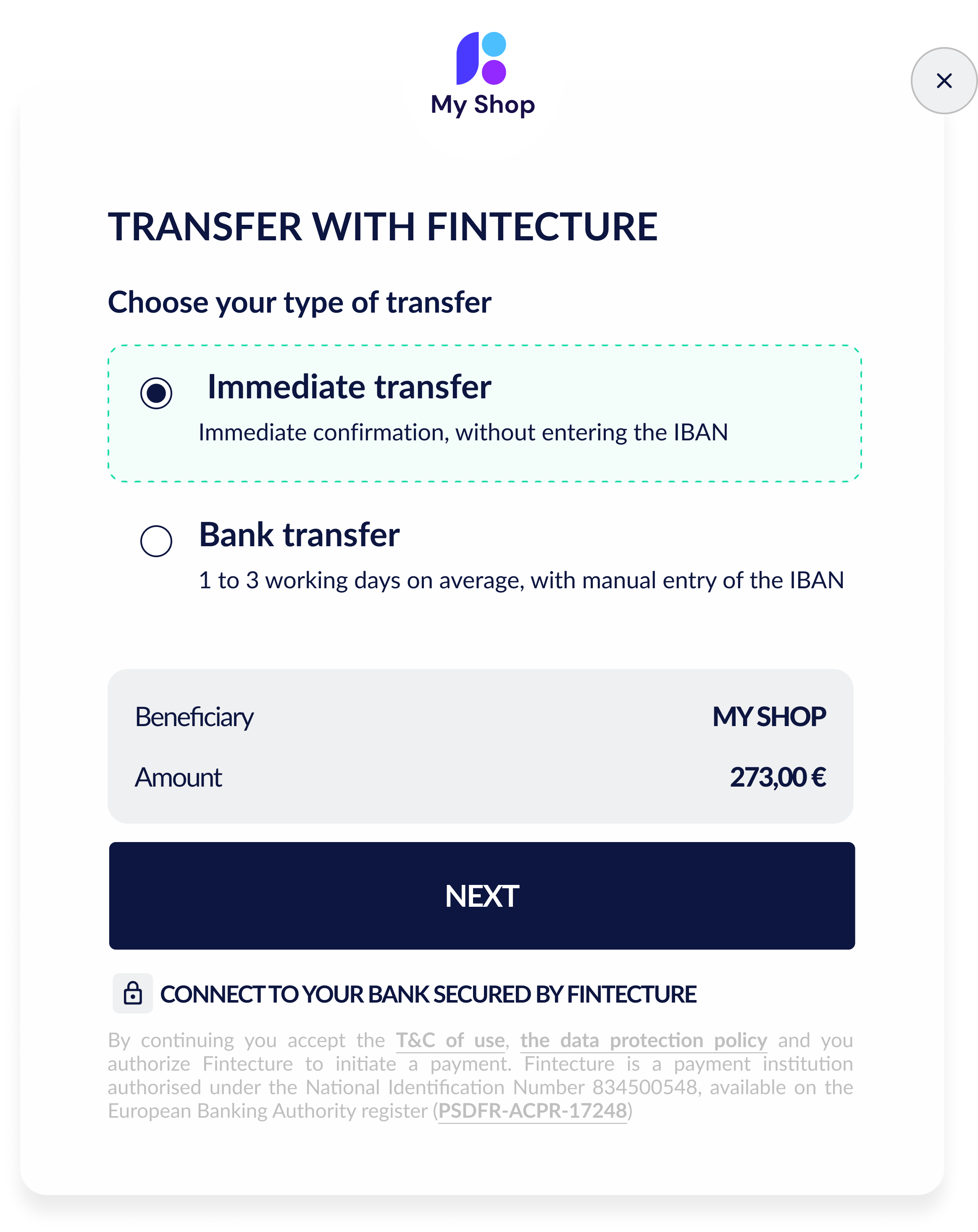
Payment by Immediate Transfer is available for all sales channels:
- For online payments: the Checkout Solution is the perfect complement to credit card or split payments on your e-commerce sites. Installation is fast. A plug-in is available for the main CMS on the market (Prestashop, Magento...).
- For offline payments (at a physical point of sale, by telephone, etc.): the Payment Request allows you to send a payment request by link or QR Code.
Find out more about Immediate Transfer and visualize the customer journey, ask us for a demonstration.
Immediate and deferred payment transfers
Some customers prefer to use checks because the processing time required to cash them gives them a "free" payment period. Some even ask you to cash it at a later date to benefit from a deferred payment.
Contrary to popular belief, Immediate Transfer and deferred payment are not incompatible! Quite the contrary, in fact. For your customers who need a payment delay, you can generate a payment link and specify a due date for your customers to schedule their transfer.
To learn more about this option, contact our teams.
1/ Banque de France data (2020)
2/ Oney survey
3/ "Les Français & le paiement". OpinionWay-ACI Worlwide study (November 2021)
4/ Banque de France - Payment security observatory (2021)
5/ Survey "Les Français et les moyens de paiement" - CSA (2015)


